Explore our flagship raw materials purpose-built for whitening & brightening formulation development.
Hyaluronic Acid (HA) — chemically known as sodium hyaluronate — is a naturally occurring glycosaminoglycan renowned for its extraordinary water-retention capacity. A single gram of HA can hold up to six liters of water, making it one of the most powerful humectants in modern cosmetic formulation. While HA has long been celebrated as a hydration powerhouse, its role in whitening and brightening product development has emerged as one of the most exciting frontiers in the global skincare industry.
The mechanism by which HA boosts whitening and brightening is multifaceted. At the molecular level, HA forms a hydrated film over the skin surface that temporarily reduces transepidermal water loss (TEWL), plumping the stratum corneum and increasing the permeability window for co-formulated actives. This means that whitening agents like Vitamin C derivatives, Kojic Dipalmitate, and Alpha Arbutin can penetrate more effectively when HA is present in the formulation matrix.
Furthermore, HA's anti-inflammatory properties help neutralize post-UV oxidative stress — a primary driver of hyperpigmentation. By suppressing inflammatory cytokines that trigger melanin overproduction, HA acts as a biological moderator, preventing dark spot formation at the cellular signaling level. This dual role — both as a delivery enhancer and a melanogenesis inhibitor — positions HA as an indispensable co-ingredient in advanced brightening systems.
Low molecular weight HA (LMW-HA, typically below 50 kDa) has demonstrated the ability to penetrate beyond the epidermis into the upper dermis, where it can modulate fibroblast activity and support collagen synthesis. This deeper action contributes to a more even skin tone and improved skin luminosity over time, addressing not just surface dullness but structural causes of uneven pigmentation.
A sophisticated approach increasingly adopted by leading cosmetic brands is the use of multi-molecular weight HA blends. By combining high molecular weight HA (HMW-HA, >1,000 kDa) for surface hydration and barrier reinforcement with medium and low molecular weight variants for deeper penetration, formulators can engineer a layered brightening effect. HMW-HA creates a reflective, light-diffusing film on the skin surface — instantly improving the visual appearance of luminosity — while LMW-HA works at depth to address melanin distribution and promote cellular renewal.
This stratified delivery strategy is particularly effective in brightening serums, ampoules, and sheet mask essences, where formulators seek both immediate and long-term efficacy claims. The inclusion of cross-linked HA (used in injectable aesthetics) is also being explored in topical applications to extend residence time and create a sustained-release depot for co-actives.
The convergence of skin hydration and pigmentation science is reshaping the global cosmetics ingredient landscape.
The global HA market in cosmetics is projected to exceed USD 15 billion by 2030, with whitening and brightening applications accounting for the fastest-growing segment. Asia-Pacific markets — particularly China, Japan, and South Korea — are leading demand, driven by cultural preferences for luminous, even-toned skin and robust K-beauty and J-beauty innovation pipelines.
Modern HA production has shifted almost entirely to microbial fermentation (using Streptococcus zooepidemicus or Bacillus subtilis), replacing animal-derived sources. This ensures vegan-friendly, cruelty-free credentials that are now essential for premium whitening brands targeting Millennial and Gen Z consumers. Advances in precision fermentation are enabling ultra-high-purity HA grades with tightly controlled molecular weight distributions.
The clean beauty movement is accelerating demand for multifunctional ingredients. HA fits perfectly — it is naturally derived, biodegradable, non-sensitizing, and compatible with virtually all skin types. Brands are increasingly positioning HA-based brightening products with dual claims: "hydrate + brighten" and "plump + even skin tone," reducing the total ingredient count while maximizing consumer appeal.
Artificial intelligence is transforming how cosmetic chemists design HA-based brightening systems. Machine learning platforms can now predict optimal HA molecular weight combinations, concentration thresholds, and compatibility matrices with whitening actives in hours rather than months. This is dramatically accelerating time-to-market for new brightening SKUs and enabling hyper-personalized formulations at scale.
Nano-HA (molecular weight below 5 kDa) and HA-encapsulated active delivery systems are among the most exciting developments. By encapsulating unstable whitening actives like Vitamin C within HA-based nanoparticles or liposomes, formulators can dramatically improve oxidative stability, skin penetration depth, and controlled-release kinetics — translating to clinically measurable brightening outcomes.
Regulatory frameworks governing whitening ingredients are evolving globally. HA's excellent safety profile — with no known sensitization, irritation, or systemic toxicity — gives it a significant compliance advantage over controversial whitening agents. This positions HA as a cornerstone ingredient for brands seeking global market access across EU, US FDA, and ASEAN regulatory environments simultaneously.
From luxury serums to mass-market brightening essences — HA enables innovation across every product category.
High-concentration HA serums (1–2% HMW + LMW blend) combined with Ascorbyl Glucoside or Kojic Dipalmitate deliver a potent hydrate-and-brighten dual action. The HA matrix stabilizes the Vitamin C derivative against oxidation, extending shelf life and improving clinical efficacy. These formulations command premium price points and are the fastest-growing subcategory in prestige skincare globally.
Sleeping masks leveraging HA's occlusive-like film-forming properties create an ideal overnight microenvironment for whitening actives. Extended skin contact time (6–8 hours) with an HA-Azelaic Acid or HA-Mandelic Acid combination enables measurable reduction in melanin index after just 4 weeks of use, making this format particularly compelling for clinical-grade brightening claims.
The integration of HA into SPF formulations addresses a critical unmet need: UV protection combined with active brightening. HA helps counteract the drying effect of chemical UV filters while its antioxidant-supporting properties reduce UV-induced melanogenesis. This "protect and brighten" positioning is particularly strong in the Asian market, where daily sun protection is deeply embedded in skincare routines.
Sheet masks remain the dominant brightening delivery format in East Asia. HA-rich essences at 0.5–1.5% concentration serve as the carrier base, enabling deep saturation of brightening actives into the skin during the 15–20 minute application window. Ampoule-grade HA with targeted brightening actives is also gaining traction as a professional-use treatment in aesthetic clinics and spas.
The "beauty from within" trend is opening a new frontier for HA in oral brightening supplements. Oral HA (typically 120–240 mg/day) has shown clinical evidence of improving skin hydration, elasticity, and luminosity. Combined with oral Vitamin C, Glutathione, and plant-based brightening extracts, HA-based ingestible beauty products represent a high-growth adjacent market for cosmetic ingredient suppliers.
HA is increasingly incorporated into color cosmetics with brightening claims. In BB creams and tinted moisturizers, HA provides immediate skin-plumping and light-diffusing effects that visually enhance skin radiance, while co-formulated whitening actives work progressively to improve underlying skin tone. This "instant + progressive" brightening positioning is a powerful marketing narrative driving premiumization in the hybrid cosmetics segment.
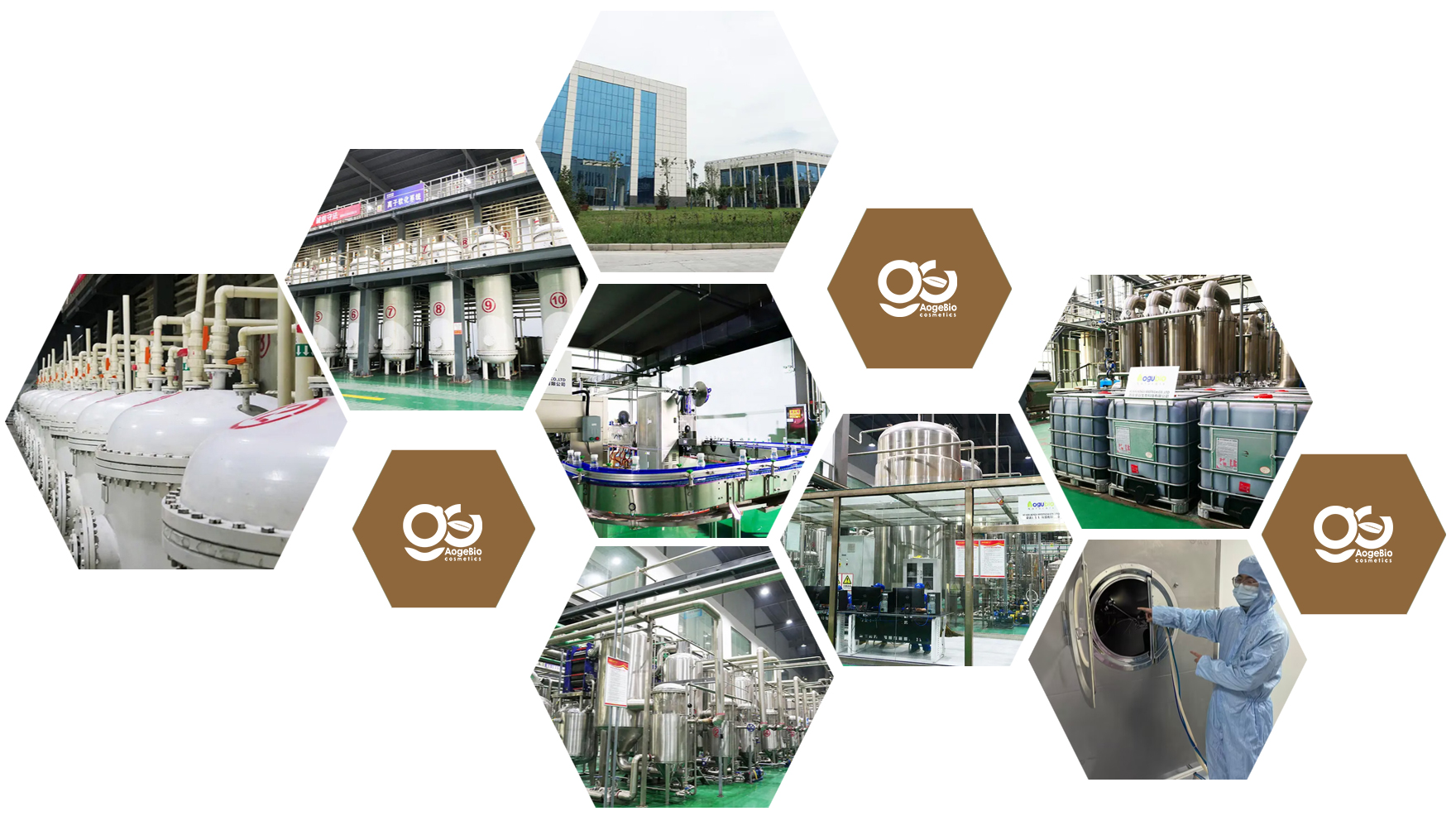
Founded in 2013 and headquartered in the prestigious high-tech zone of Xi'an, Xi'an Aoge Biotech Co., Ltd., along with its subsidiaries Xi'an Imaherb Biotech Co., Ltd. and Xi'an Nahanutri Biotech Co., Ltd., has established itself as a leading force in the cosmetics raw materials industry.
Our expansive cooperative factory, spanning 1,000 mu (approximately 165 acres), is equipped with state-of-the-art extraction technology. This advanced infrastructure allows us to manufacture a wide array of premium cosmetic raw materials. Our product line includes natural plant extracts specifically designed for organic cosmetics, as well as synthetic ingredients for high-end skincare formulations.
These raw materials serve as the foundation for a multitude of skincare, haircare, and makeup products, ensuring superior quality and efficacy throughout the entire production process.
Our in-house laboratory is equipped with cutting-edge instruments for rigorous quality control. We utilize UPLC and HPLC for analyzing active components, GC and GC-MS for detecting solvent residues, ICP-MS for identifying heavy metals, and GC/LC-MS-MS for assessing pesticide residues. Additionally, we employ HPTLC and IR for identification purposes, ELISA for determining ORAC values, PSL for evaluating irradiation residues, and conduct comprehensive microbiology tests. These measures guarantee that our raw materials adhere to stringent international standards.
At Aogebio, innovation, quality, and sustainability are the bedrock of our corporate philosophy.
We pour relentless efforts into research and development, constantly exploring novel raw materials and advanced manufacturing techniques to stay ahead in the dynamic cosmetics industry.
Rigorous quality control is embedded in every step of our production process, from raw material sourcing to final product delivery, guaranteeing that each item adheres to the most stringent international standards.
We actively embrace sustainable practices, striving to minimize our environmental footprint through eco-friendly production methods and responsible sourcing.
This unwavering dedication enables us to consistently offer products of unparalleled excellence and contribute to the long-term, healthy development of the entire cosmetics industry.
Comprehensive cosmetic-grade raw materials for your full whitening & brightening formulation needs.